 CauTrigger#
[

Deciphering biological system state transitions by hierarchical causal decomposition
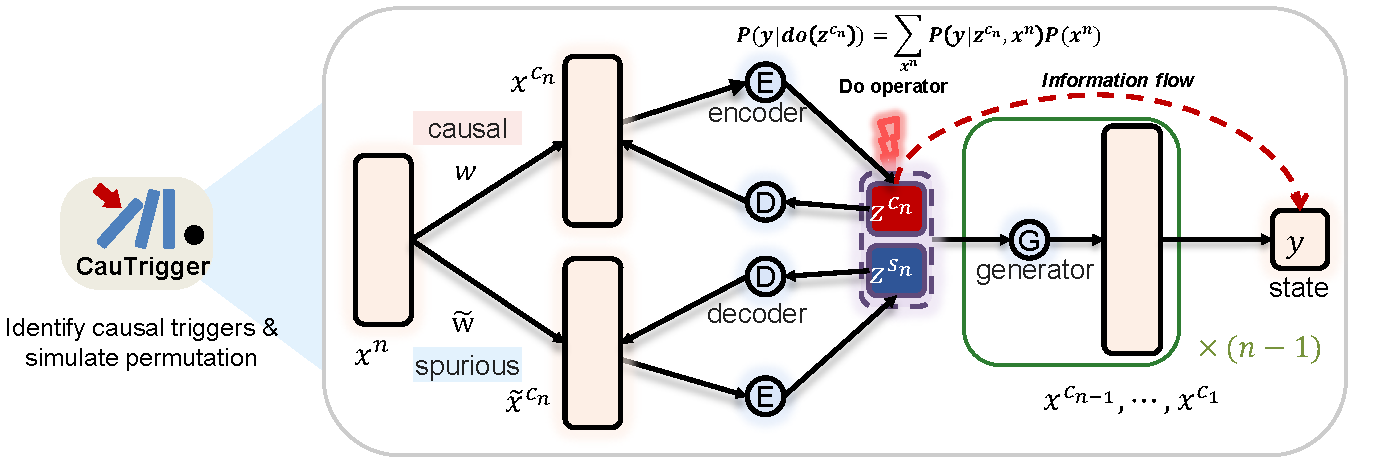
CauTrigger is a causal decoupling model constructed on a dual-flow variational autoencoder (DFVAE) framework to identify causal triggers that influence biological state transitions in a hierarchical manner. Triggers (\(x^n\)) are processed through a feature selection layer to separate causal triggers (\(x^{c_n}\)) and others (\(\tilde{x}^{c_n}\)), and are then encoded into a latent space \(z\) that consists of causal (\(z^{c_n}\)) and spurious (\(z^{s_n}\)) components. This latent space is decoded to generate downstream conductors (\(x^{c_{n-1}}, \dots, x^{c_1}\)) and to predict the final cell state (\(y\)). The model strives to maximize the causal information flow \(I(z^{c_n} \rightarrow y)\) from \(z^{c_n}\) to \(y\), thereby delineating hierarchical causal paths from \(x^{c_n}\) to \(y\) via \(z^{c_n}\).
Getting started#
Please refer to the documentation for installation instructions, API reference, and end-to-end tutorials.
Tutorials at a glance#
The documentation includes four end-to-end tutorials (see the tutorials section):
Two-layer synthetic causal simulation – demonstrates how CauTrigger recovers known causal vs. spurious features in a controlled two-layer system.
hESC differentiation causal analysis – applies a two-layer TF/TG model to human embryonic stem cell differentiation (0 h vs 96 h).
T2D multi-omics causal analysis – uses a three-layer TF–CRE–TG hierarchy to analyze pancreatic islet multi-omics in control, pre-T2D, and T2D donors.
Gut–brain axis hierarchical analysis in ASD – models microbiota → host proteome → ASD states to illustrate hierarchical triggers and in silico perturbation.
For new applications, we recommend starting from the tutorial whose data structure is closest to your own dataset and adapting the data-preparation steps accordingly.
Installation#
You need to have Python 3.10 or newer installed on your system. Installation usually finishes within a few minutes.
pip install git+https://github.com/ChengmingZhang-CAS/CauTrigger.git@main
The velocyto package is used to access the colDeltaCorpartial function for calculating local partial correlations. Since this function depends on Cython extensions, prerequisites like Cython and NumPy must be pre-installed. For the full installation guide, please refer to the official documentation velocyto-install.
Analyze your own datasets#
Step 1: Prepare your dataset#
Core AnnData structure
adatais a preprocessedAnnDataobject (cells inobs, features invar).adata.varhas a unique index (e.g. gene symbols).adata.obshas a unique index for all cells.
State labels
The system state \(y\) is stored in a numeric column
"labels"inadata.obs.For binary tasks (
n_state = 2),"labels"should lie in [0, 1] (e.g. 0/1 or continuous values).For multi-class tasks (
n_state > 2),"labels"contains integer class indices 0, 1, …,n_state - 1.
Hierarchical inputs (2-layer / 3-layer)
For CauTrigger-2L or 3L,
adata.obsmcontains the downstream feature matrices, e.g.'X_down'or ('X_down1','X_down2'). See the tutorials for complete two-layer and three-layer examples.
Step 2: Run CauTrigger#
model = CauTrigger1L(adata)
model.train()
Step 3: Analysis#
Select potential causal triggers. By default, SHAP-based attribution is used; you may optionally switch to gradient-based attribution by setting method="Grad".
topk = 10
weight_df_weight1 = model.get_up_feature_weights(
    normalize=True,
    method="SHAP",  # default; use "Grad" for gradient-based attribution
    sort_by_weight=False
)[0]["weight"]
causal_factors_layer1_indices = np.argsort(weight_df_weight1)[-topk:][::-1]
Visualize the causal latent space and then you can do in silico perturbation on it or other embeddings (e.g. UMAP):
adata.obsm["X_ct"] = model.get_model_output()["latent"][:, :2]
Contact#
For questions, discussions, or bug reports, please use the GitHub issue tracker.
GitHub Issues: https://github.com/ChengmingZhang-CAS/CauTrigger/issues
Citation#
t.b.a